- Products
- Solutions
- Services
- Resources
- Customer Success
- Company
- Sign In
- Contact Us


Our previous blog touched on all the major factors on why you should invest in a custom CRM for your business. In case you missed it, here’s the link. Part 2 will carry these thoughts forward with an in-depth analysis of reasons for investing in a custom CRM built on HokuApps rapid mobile app development platform and its impact on business processes.
Before the creation of the app, cross-platform mobile app development solution providers need to chart a framework for effective implementation. There are a lot of factors that go into this:
Though a lot of mainstream businesses might give you a short timeline of four weeks. This is just the initial creation time, or what we call a prototype. The total time for full deployment and use spikes up to one year on an average. However, with apps made on the RAD model, total time can come down to about 8 weeks (for manufacturing).
Until a decade ago, CRM and media were two separate fields. With cross-platform rapid mobile app development, the two fields find themselves combined. CRMs can now talk to systems that were previously disconnected. Your systems can run on auto-pilot while you concentrate on decision making and on the creative side of your business.
With this development, it can become a practice to have conversations with your customers and for them to register their voices on their CRM profiles. Apart from all essential communication channels, you could also get their feedback through surveys through the app. Your business can build concrete relationships by providing excellent customer experiences.
Both consumers and businesses can gain a lot from taking a data-driven approach to marketing. Here are all the major benefits:
All of this adds to garnering loyal customers who then go on to becoming organic influencers for your business.
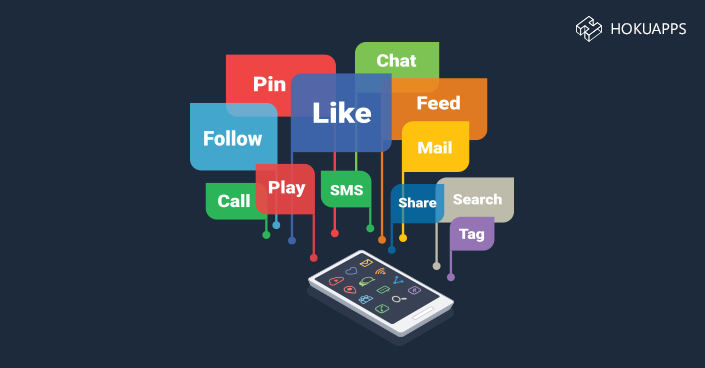
Social media is a great way to interact with clients in real-time. This allows businesses to gather data based on behaviors and demographics, driven by value creation and loyalty building. From a marketing standpoint, Social CRM targets content and promotions based on data collected through social media and a CRM app. This strategy will definitely garner leads. Later, the sales team can understand their customer’s needs via analytics provided by the CRM app by combining social media data and other communications.
Here’s how this works:
Basically, Social CRM reaches out to prospects and existing customers on all social media touch points to improve customer experience. Now, your social media strategy is working as expected. But how do you measure the impact and make changes based on it? Connect your CRM to a social media analytics tools to understand specific metrics.
As BYOD (Bring Your Own Devices) becomes a norm with enterprises globally, many businesses are expanding mobile apps deployments to reach their workforce, customers, partners, and suppliers. Mobile apps have helped businesses move beyond traditional work environments.
It’s a simple fact. Laptops are expensive and cumbersome to carry around for field operatives. Mobiles are a great way to carry custom integrated location-based real-time tools. Mobile CRM can enhance field processes by:
Inherent risks for mobile apps cannot be underrated. And with the BYOD culture spreading like wildfire, each of these devices become key points for hackers to steal sensitive data.
Here are the most common security breach touchpoints:
The best way to curtail malware is to secure the app services to which your business is connected to. The app design itself should have an ingrained security feature to stop Secure Sockets Layer (SSL)/Transport Layer Security (TLS) vulnerabilities. While companies develop apps, binary static and behavioral analysis codes should be incorporated to assess threats in real-time. This allows prompt recognition of malicious codes in the application’s coding.
Your app would probably be designed for usage by customers as well as your field workforce. A Forrester review suggests that with mainstream mobile app developed software, around 65% of your total costs would be spent on maintenance. However, with Low Code development platform made apps, maintenance costs drop would be immense.
Here are the niches that your app development partner should support your business with for optimum app performance and lower costs to the company:

Best security practices should include (based on development phases):
Creating mobile apps can be a complex task. It’s not just the codes but other factors like cross-platform mobile development app used, 3rd party services, web-services etc. work their part in affecting the inner working of the app. You will need to take into consideration all aforementioned factors to make a clear decision on the best suited mobile app development partners.
However, with the HokuApps mobile app development platform, all the above-mentioned points are taken care of automatically. This is because we reuse codeing components and integrate the app with more than 500 API connectors to make sure that you get a secure app at rapid speed.
Read our case study on the US-based PTI QCS here to understand the Hoku advantage…
For more information on Custom CRM solutions, talk to our experts here…